
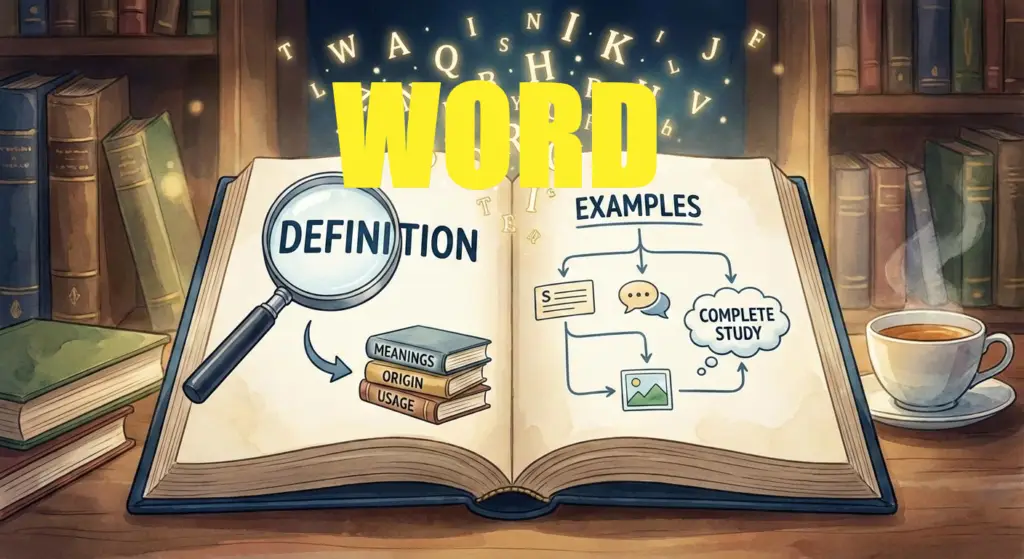
Introduction of word
Imagine you are at a restaurant. Without words, you might have to point and grunt to get food. With just one word—“Water”—the waiter knows exactly what you need. Words are the “shortcuts” of human life; they allow us to share complex needs very quickly.
Therefore understanding the ‘what is a word’ is the first step to mastering the English language. Every sentence you speak or write is built from these individual units of meaning.
“Learn more vocabullary to be a better communicator or wise person.” as it is said, “Someone with a rich vocabullary and understands how to use these words correctly is often considered wise and a better communicator.”
-Rajesh Huika
“The power of words is immense. A well-chosen word has often sufficed to stop a flying army, to change defeat into victory and to save an empire.”-Emile de Girardin
“Words have power. Words created this universe… Everything started with the Word. The Bible says, ‘In the beginning was the word.’ In the same way, your words have creative power.”- Bo Sanchez
A word is the smallest piece of a language that can stand by itself and mean something.
- “Apple” means a fruit.
- “Run” means an action.
- “Blue” means a color.
If you break these words into smaller letters (like a-p-p-l-e), the letters alone don’t have a meaning. The word is where the magic starts.
Words are like “labels” for everything in the world.
- The Physical: Table, dog, sun.
- The Invisible: Love, happy, tomorrow.
Without words, these things would still exist, but we wouldn’t be able to share our thoughts about them with anyone else.
Words are the Building Blocks of Sentences. While a word has meaning on its own, its real power comes when it joins others.
- Word: Hungry. (One idea)
- Sentence: I am very hungry. (A complete story)
To be a word, a sound or a group of letters usually needs three things:
- A Sound: How it sounds when you speak (e.g., /dog/).
- A Symbol: How it looks when you write it (e.g., D-O-G).
- A Meaning: The picture that pops into your mind (e.g., 🐕).
Definition of the word
A word is a letter or group of letters that has a specific meaning when spoken or written. In other words, a word is a pronounceable letter or series of letters bearing a particular meaning. In simple terms, a word is a pronounceable sound or series of letters having a particualr Meaning. If a combination of letters (like “ASDF”) has no meaning, it is not a word.
Meaning of the word
- A sound or combination of sounds that have meaning and it is spoken by a human being is called a word. It means, if a sound has no meaning, then it is not a word. “
GandASDF” are not words as these letters are not giving any particular meaning. - A pronounceable letter or series of letters having a particular meaning.
- A letter or letters which give meaning.
Examples of word
Any sound we hear is either a letter or a word and every word has a specific meaning. For instance: A, I, Freedom, Courage, Endure, Wisdom, Truth, Josh, English, Success, Teacher, Good, friend, etc. are words.
Joy, Endure, Wisdom (Examples of Word)
Courage, Vivacity, Bliss (Word examples)
Truth, Inspire, Perseverance, Josh (Exaples for word)
“is a single alphabet that still has complete meaning. Likewise, “I” also has its own meaning. Do you know? A and I are the smallest words in the English language.
‘A’ is an indefinite article in English that refers to one thing or person when we use it before the noun groups. Similarly, when ‘I’ is used as a word in English refers to the personal pronoun.
The Smallest Words in English
Did you know that a single letter can be a word? The smallest words in the English language are “A” and “I”.
“A” is an indefinite article used before nouns.
“I” is a personal pronoun used to refer to oneself.
The Longest Words in English
- Longest word: Pneumonoultramicroscopicsilicovolcanoconiosis (45 letters).
- Other Long Words: Pseudopseudohypoparathyroidism (30 letters), and Supercalifragilisticexpialidocious (34 letters)
Whether it is the longest or the smallest, all the words that have meaning and are used in spoken and written English are found in the Dictionary, and they are categorised into 08 types, often known as 08 Parts of Speech in English grammar or Word Classes. Generaly, these parts of speech describe the emotion, behavior, and action of a human being.
Parts of speech in English
All the words that have meaning come under Word Classes. Significantly, there are 08 parts of speech in English grammar. They are as follows:
- Noun: Ram, Delhi, February, Rive, Book, etc.
- Pronoun: I, We, You, He, She, It, They, etc.
- Adjective: Beautiful, White, Big, Tall, Kind, Honest, etc.
- Verb: Go-went-Gone, Eat-ate-Eaten, Do-did-done, etc.
- Adverb: Happily, Quickly, Rapidly, Now, Yesterday.
- Preposition: At, In, On, Between, Among, etc.
- Conjunction: and, or, not only but also, either or, neither nor, etc.
- Interjection: Hamm!, Wow!, Ups!, Bravo!, Hurry up!, God!
Analyzing Words Within Sentences
A sentence is a group of words that expresses a complete thought. Let’s break down how different words function together:
Example 1
“I pushed the car.”
- I: Pronoun (Subject)
- Pushed: Verb (Action)
- The: Article (Determiner)
- Car: Noun (Object)
Example 2
“I enjoy his company because he tells stories.”
- Enjoy: Verb
- His: Possessive Pronoun
- Because: Conjunction (Connecting two ideas)
- Stories: Noun (Plural)
Example 3
I pushed the car. As a result, it moved.
- ‘I‘ is a word, and it is the personal pronoun,
- ‘Pushed‘ is a verb.
- ‘The’ is a definite article.
- ‘Car’ is a noun.
- ‘As a result ‘ is a transition.
- ‘It’ is an objective personal pronoun, used as a subject.
- ‘Moved’ is a verb.
Example 4
I enjoy his company because he always tells amazing stories.
- ‘I’ is the subject and it is a personal pronoun,
- ‘enjoy’ is a verb,
- ‘his’ is a possessive pronoun,
- ‘company’ noun,
- ‘because’ is a conjunction or transition,
- ‘he’ is a personal pronoun,
- ‘always’ is an adverb,
- ‘tells’ is a verb.
- ‘Amazing’ is an adverb, and
- ‘stories’ is a noun of the plural form of a story.
Example 5
I and my mother both love to travel
- “I” a is a word and it is the personal pronoun,
- “and” is a conjunction or transition,
- “my” is a possessive pronoun,
- “mother” is a noun’
- “both” is a pronoun.
- “love” is an abstract noun.
- “to” is a preposition.
- “Travel” is a (verb), travel (noun), traveled (adjective), traveling (adjective), traveling salesman (noun).
Now, you must have comprehended clearly after studying about word or words that every sentence consists of a group of words and each sentence has its own meaning.
After seeing the above examples, you must have already known that a sentence is nothing but a set of words. Let’s see, more examples, how words are used in sentences.
Exercise-1
Identify the part of speech for each word in the following sentences:
- I am not fond of chocolate; however, I like cakes.
- He is not rich, yet he is happy.
- Today I will write an essay. In addition, I will compose a poem.
- She not only sings melodiously but also dances well.
Exercise-2
Write separately and to clarify, name all the words of the below-listed sentences.
- I am not fond of Chocolate. However, I like Cakes.
- He is not rich yet he is happy.
- I am tired, therefore, I am going to bed.
- Work hard; otherwise, you will fail.
- He is not only my friend but also my classmate.
- Today I will write an essay. In addition, I will compose a poem.
- My neighbor and my father are good friends.
- He tried to open the door, but the door was locked.
- There are many reasons to learn more vocabulary. Above all, it improves your knowledge.
- In the afternoon, I would like to relax. For instance, I will go to a movie.
- You may stay here or go home.
- I am ill with a fever nevertheless I shall sit for the examination.
- It rained heavily, therefore I could not go out.
- In conclusion, one who has more word power is a wise man.
- She not only sings melodiously but also dances well.|
“A journey of a thousand miles begins with a single step”
Lao Tzu
Answer Key
Exercise‑1
Sentence 1:
I am not fond of chocolate; however, I like cakes.
- I → Pronoun
- am → Verb (linking verb)
- not → Adverb
- fond → Adjective
- of → Preposition
- chocolate → Noun
- however → Conjunction (transitional)
- I → Pronoun
- like → Verb
- cakes → Noun
Sentence 2:
He is not rich, yet he is happy.
- He → Pronoun
- is → Verb
- not → Adverb
- rich → Adjective
- yet → Conjunction
- he → Pronoun
- is → Verb
- happy → Adjective
Sentence 3:
Today I will write an essay. In addition, I will compose a poem.
- Today → Adverb
- I → Pronoun
- will → Auxiliary verb
- write → Verb
- an → Article
- essay → Noun
- In addition → Conjunctive phrase
- I → Pronoun
- will → Auxiliary verb
- compose → Verb
- a → Article
- poem → Noun
Sentence 4:
She not only sings melodiously but also dances well.
- She → Pronoun
- not only → Correlative conjunction
- sings → Verb
- melodiously → Adverb
- but also → Correlative conjunction
- dances → Verb
- well → Adverb
Exercise‑2:
Lest first break downs the words:
- I / am / not / fond / of / Chocolate. / However, / I / like / Cakes.
- He / is / not / rich / yet / he / is / happy.
- I / am / tired, / therefore, / I / am / going / to / bed.
- Work / hard, / otherwise, / you / will / fail.
- He / is / not / only / my / friend / but / also / my / classmate.
- Today / I / will / write / an / essay. / In / addition, / I / will / compose / a / poem.
- My / neighbor / and / my / father / are / good / friends.
- He / tried / to / open / the / door / but / the / door / was / locked.
- There / are / many / reasons / to / learn / more / vocabulary. / Above / all, / it / improves / your / knowledge.
- In / the / afternoon, / I / would / like / to / relax. / For / instance, / I / will / go / to / a / movie.
- You / may / stay / here / or / go / home.
- I / am / ill / with / a / fever / nevertheless / I / shall / sit / for / the / examination.
- It / rained / heavily, / therefore / I / could / not / go / out.
- In / conclusion, / one / who / has / more / word / power / is / a / wise / man.
- She / not / only / sings / melodiously / but / also / dances / well.
Sentence 01:
I / am / not / fond / of / Chocolate. / However, / I / like / Cakes.
- I → Pronoun
- am → Verb (linking)
- not → Adverb
- fond → Adjective
- of → Preposition
- Chocolate → Noun
- However → Conjunction (transitional)
- I → Pronoun
- like → Verb
- Cakes → Noun
Sentence 02:
He / is / not / rich / yet / he / is / happy.
- He → Pronoun
- is → Verb
- not → Adverb
- rich → Adjective
- yet → Conjunction
- he → Pronoun
- is → Verb
- happy → Adjective
Sentence 03:
I / am / tired, / therefore, / I / am / going / to / bed.
- I → Pronoun
- am → Verb
- tired → Adjective
- therefore → Conjunction (transitional)
- I → Pronoun
- am → Verb
- going → Verb (present participle)
- to → Preposition
- bed → Noun
Sentence 04:
Work / hard, / otherwise, / you / will / fail.
- Work → Verb (imperative)
- hard → Adverb
- otherwise → Conjunction
- you → Pronoun
- will → Auxiliary verb
- fail → Verb
Sentence 05:
He / is / not / only / my / friend / but / also / my / classmate.
- He → Pronoun
- is → Verb
- not → Adverb
- only → Adverb (part of correlative conjunction “not only”)
- my → Pronoun (possessive adjective)
- friend → Noun
- but → Conjunction
- also → Adverb (part of correlative “but also”)
- my → Pronoun (possessive adjective)
- classmate → Noun
Sentence 06:
Today / I / will / write / an / essay. / In / addition, / I / will / compose / a / poem.
- Today → Adverb
- I → Pronoun
- will → Auxiliary verb
- write → Verb
- an → Article
- essay → Noun
- In → Preposition
- addition → Noun (used in conjunctive phrase “in addition”)
- I → Pronoun
- will → Auxiliary verb
- compose → Verb
- a → Article
- poem → Noun
Sentence 07:
My / neighbor / and / my / father / are / good / friends.
- My → Pronoun (possessive adjective)
- neighbor → Noun
- and → Conjunction
- my → Pronoun (possessive adjective)
- father → Noun
- are → Verb
- good → Adjective
- friends → Noun
Sentence 08:
He / tried / to / open / the / door / but / the / door / was / locked.
- He → Pronoun
- tried → Verb
- to → Particle (infinitive marker)
- open → Verb
- the → Article
- door → Noun
- but → Conjunction
- the → Article
- door → Noun
- was → Verb
- locked → Adjective (past participle used as adjective)
Sentence 09:
There / are / many / reasons / to / learn / more / vocabulary. / Above / all, / it / improves / your / knowledge.
- There → Pronoun (introductory)
- are → Verb
- many → Adjective
- reasons → Noun
- to → Particle (infinitive marker)
- learn → Verb
- more → Adjective
- vocabulary → Noun
- Above → Preposition/Adverb
- all → Pronoun (used in phrase “above all”)
- it → Pronoun
- improves → Verb
- your → Pronoun (possessive adjective)
- knowledge → Noun
Sentence 10:
In / the / afternoon, / I / would / like / to / relax. / For / instance, / I / will / go / to / a / movie.
- In → Preposition
- the → Article
- afternoon → Noun
- I → Pronoun
- would → Auxiliary verb
- like → Verb
- to → Particle (infinitive marker)
- relax → Verb
- For → Preposition
- instance → Noun
- I → Pronoun
- will → Auxiliary verb
- go → Verb
- to → Preposition
- a → Article
- movie → Noun
Sentence 11:
You / may / stay / here / or / go / home.
- You → Pronoun
- may → Auxiliary verb
- stay → Verb
- here → Adverb
- or → Conjunction
- go → Verb
- home → Noun/Adverb
Sentence 12:
I / am / ill / with / a / fever / nevertheless / I / shall / sit / for / the / examination.
- I → Pronoun
- am → Verb
- ill → Adjective
- with → Preposition
- a → Article
- fever → Noun
- nevertheless → Conjunction
- I → Pronoun
- shall → Auxiliary verb
- sit → Verb
- for → Preposition
- the → Article
- examination → Noun
Sentence 13:
It / rained / heavily, / therefore / I / could / not / go / out.
- It → Pronoun
- rained → Verb
- heavily → Adverb
- therefore → Conjunction
- I → Pronoun
- could → Auxiliary verb
- not → Adverb
- go → Verb
- out → Adverb
Sentence 14:
In / conclusion, / one / who / has / more / word / power / is / a / wise / man.
- In → Preposition
- conclusion → Noun
- one → Pronoun
- who → Pronoun (relative)
- has → Verb
- more → Adjective
- word → Noun
- power → Noun
- is → Verb
- a → Article
- wise → Adjective
- man → Noun
Sentence 15:
She / not / only / sings / melodiously / but / also / dances / well.
- She → Pronoun
- not → Adverb
- only → Adverb (part of correlative “not only”)
- sings → Verb
- melodiously → Adverb
- but → Conjunction
- also → Adverb (part of correlative “but also”)
- dances → Verb
- well → Adverb