
1. What is a pronoun?
A pronoun is a word that replaces a noun or noun phrase.
- The man saw the girls.
- The girls were playing.
- However, the girls did not see the man.
- The man went on watching the girls.
The sentences above can be revised to include pronouns as follows:
- The man saw the girls.
- They were playing.
- However, they did not see the man.
- He went on watching them.
Now it sounds better. The noun “girls” has not been used repeatedly. Instead of the noun “girls,” we used the pronoun “they.” In the same way, we used the pronoun “he” to refer to the noun “man.”
Now you should understand that pronouns are used instead of nouns. Using the same noun repeatedly can sound awkward.
2. Types of Pronouns
There are seven types of pronouns, which are as follows:
- Personal Pronoun.
- Demonstrative Pronoun.
- Interrogative Pronoun.
- Reflexive Pronoun.
- Emphasizing Pronouns.
- Possessive Pronoun.
- Relative Pronoun.
Now, let’s learn about these 07 kinds of pronouns in detail one by one.
I. Personal Pronouns
A Pronoun that stands for a person or a thing is called a ‘Personal Pronoun.’
There are 03 kinds of ‘personal pronouns.’ They are as follows:
| PERSON | SINGULAR | PLURAL |
| 1st Person | I | WE |
| 2nd Person | YOU | YOU |
| 3rd Person | He, she, or It | They |
Examples of ‘Personal Pronouns’
- I eat ice cream.
- We eat ice cream.
- You eat ice cream.
- You eat ice cream.
- He eats ice cream.
- She eats ice cream.
- It eats ice cream.
- They eat ice cream.
Note: Third person singular always takes ‘s/es‘ when they are used in the ‘present tense affirmative form.’ Further, “does” and “does not” are used in interrogative and negative simple present forms.
In the sentences above, the subjects (he, she, and it) in examples 5 to 7 are third person singular, which is why their verbs take ‘s’ or ‘es.’
II. Demonstrative Pronoun
A demonstrative pronoun is a pronoun that is used to point out the object or objects to which it refers.
For example:
- This is my computer.
- That is my TV.
- These are my books.
- Those are my notes.
In the above sentences, “this,” “that,” “these,” and “those” are used to point out the object or objects for which they are used. “This” (singular) and “these” (plural) refer to things near at hand; “that” (singular) and “those” (plural) refer to things lying at a distance. They are, therefore, called demonstrative pronouns.
Demonstrative Pronouns and Demonstrative Adjectives
The words “this,” “that,” “these,” and “those” can be used both as demonstrative pronouns and as demonstrative adjectives.
For example:
| Examples | Description |
| This is my computer. | “This” stands for the noun “computer” and is a pronoun. |
| This computer is mine. | “This“ “” qualifies the noun “computer”; therefore, it is an adjective. |
| Those are books. | “Those” stands for the noun “books” and is a pronoun. |
| Those books are mine. | “Those” qualifies the noun “books” and is an adjective. |
| These are good books. | “These” is a demonstrative pronoun. |
| These books are good. | “These” is a demonstrative adjective. |
III. Interrogative Pronoun
A pronoun that is used to ask a question is known as an interrogative pronoun.
For example:
- What is this?
- Which is your car?
- Who is he?
- Whose notes are these?
- Whom do you want to marry?
“What” and “which” are used for things or ideas. Whereas “who,” “whom,” and “whose” are used for persons
IV. Reflexive Pronoun
Reflexive pronouns are words like “myself,” “ourselves,” “yourself,” “yourselves,” “himself,” “herself,” “itself,” and “themselves,” used when the receiver of action is known as a reflexive pronoun. See the examples given below:
| PERSON | SINGULAR | Examples | PLURAL | Examples |
| 1st Person | Myself | I motivate myself. | Ourselves | We blamed ourselves. |
| 2nd Person | Yourself | Don’t ruin yourself. | Yourselves | Learn yourselves. |
| 3rd Person | Himself, Herself, Itself | 1. He/She blamed himself/herself. 2. The dog hurt itself. | Themselves | The monks work themselves. |
V. Emphasising Pronoun
When a pronoun is used only for the sake of emphasis, it is called an emphasising pronoun.
For example:
- I myself was blamed for the sake of ending the quarrel.
- You yourself must do this work.
- He himself works out his homework daily.
- They themselves went to the police station.
The bold words are the emphasised pronouns. Especially, they are used to emphasize the circumstance.
VI. Possessive Pronouns
A pronoun that shows the possessiveness of something is called a possessive pronoun.
For example:
- This is not your computer. It is mine.
- That motorbike is not mine. It is yours.
- This is not her book. It is his.
- They have bought a new car. That is theirs.
- Those books are ours.
- Rani said that those books were hers.
The words “mine,” “ours,” “yours,” “his,” “hers,” “its,” and “theirs” do not qualify as nouns. They show possession. That is why they are possessive pronouns.
VII. Relative Pronoun
The pronouns that combine two sentences and refer back to the nouns that came before them are called relative pronouns.
- I met a teacher whom I had met yesterday. (I met a teacher. I had met him yesterday.)
- This is the bag that Radhika bought. (This is the bag. Radhika bought it.)
- He is the comedian whom I met last month. He is a comedian. I met him last month.
Look, the antecedent of “whom” is the “teacher.” The noun to which a relative pronoun refers or describes is called its antecedent.
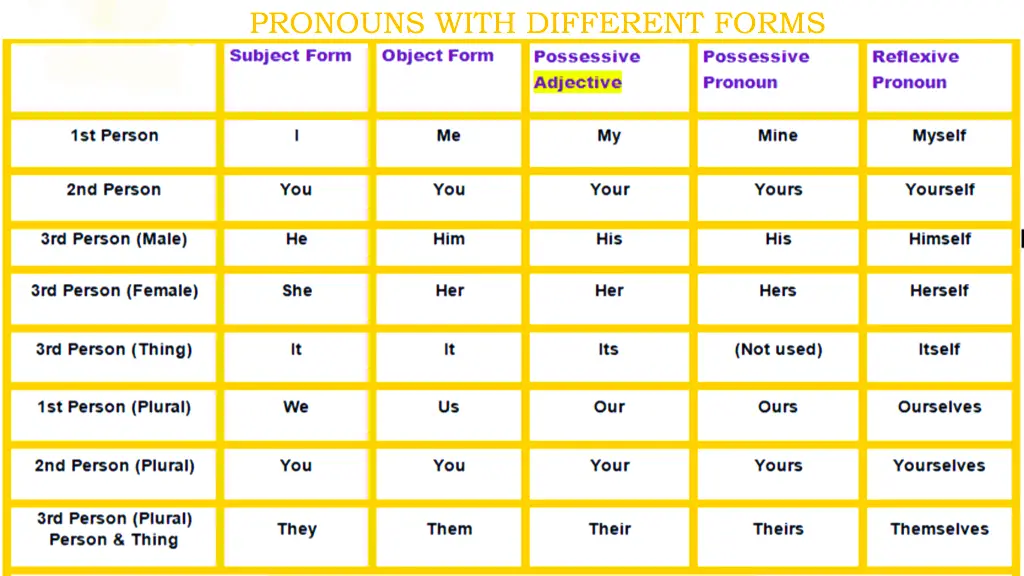
| Subject | Object form |
| I | Me |
| WE | us |
| You | (to) you |
| he | him |
| she | her |
| It | (to) it |
| They | Them |
Exercises (Pronoun)
1. Fill in the blanks with appropriate pronouns.
- The car does not belong to __________.
- Rohit likes to play with Rohan’s toys, but __________ does not care for __________.,
- Is that __________ your bag?
- I gifted my friend a pen, and __________ gifted __________ a chocolate.
- Look at the flower. How beautiful __________ is?
- When we went on shopping, __________ bought a t-shirt.
2. Fill in the blanks with interrogative pronouns.
- __________ is the new book?
- __________ told you about his matter?
- __________ is your father’s name?
- __________ books are these?
- __________ is my goal?
- How much is this lovely car?
3. Pick out the interrogative pronouns in the following sentences.
- What prize has been given to the winner?
- Whose responsibility is higher in your country?
- Who killed the Raban?
- What does your father do?
- Which way should I go?
- What types of movies do you like the most?
- Who has drawn this drawing?
4. Fill in the blanks with possessive pronouns.
- My friend often encourages me to __________.
- Generally, we often deceive __________.
- You should do your homework by __________.
- She __________ completed all her work.
- The dog has hurt __________.
5. Rewrite the following sentence as shown.
- Those toys belong to
| 1. Those toys belong to us. | Ans: Those toys are ours. |
| 2. That bag belongs to me. | Ans: |
| 3. This camera belongs to him. | Ans |
| 4. These books belong to them. | Ans: |
| 5. Those photos belong to them. | Ans: |
For more, click on the link: Pronoun
“Don’t Give up on yourself. There’s a reason why you started.”
-Rajesh Huika